
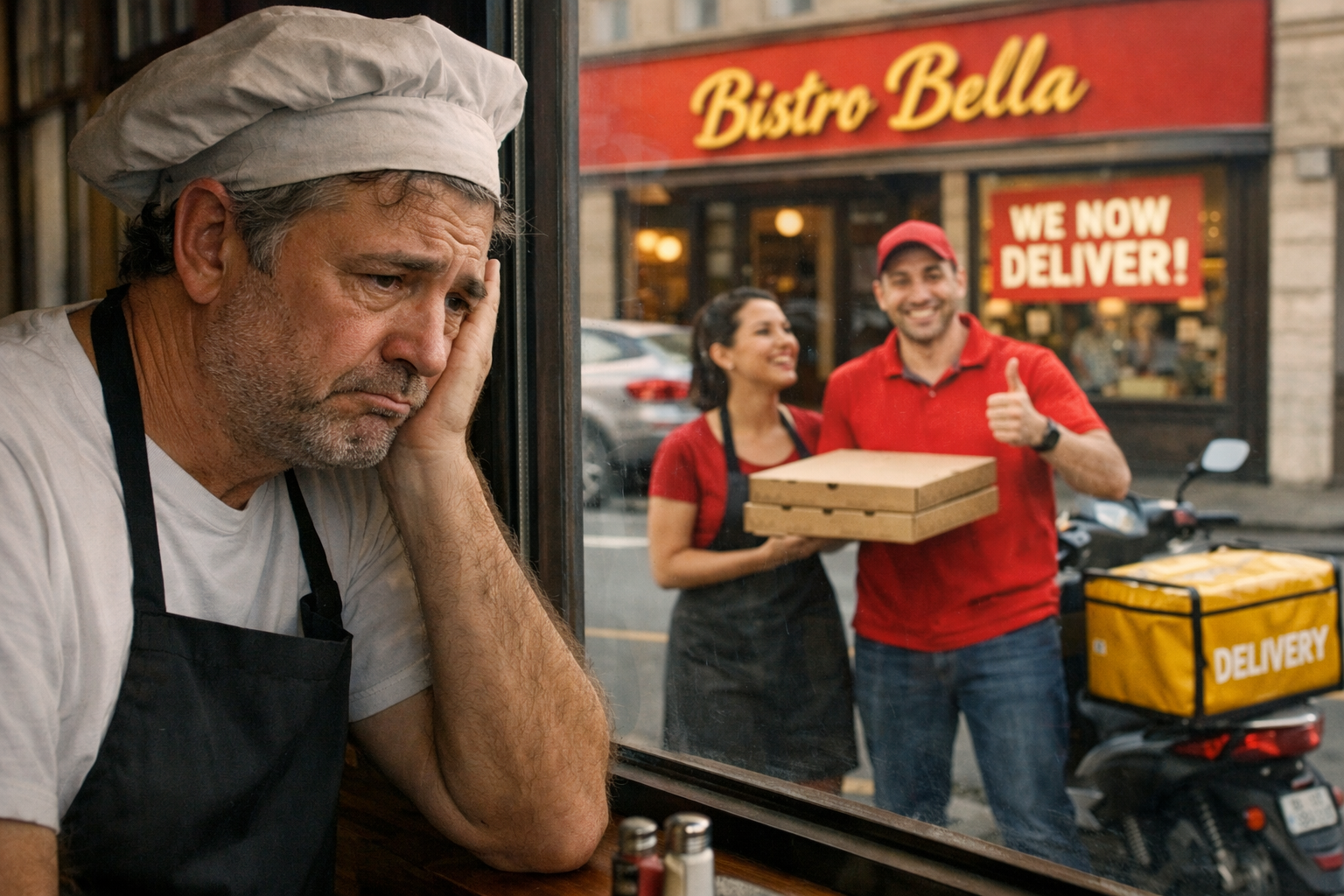
Why Takeaway is now the main event (especially in small towns)
Let’s be honest: sit-down service is lovely… until it’s 18:30, the kids are hungry, the wind is doing the most, and nobody wants to “quickly” cook anything. That’s when takeaway wins.
If you run a quick-service restaurant (QSR) or a local mom-and-pop takeaway in a small town, takeaway and delivery aren’t “nice-to-have extras” anymore. They’re how you stay competitive when the franchises arrive with big signage, big systems, and big consistency.
The good news? You don’t need to become a franchise to compete with one. You just need to become *delivery-ready*.
The hard truth: people still want your food — they just want it with less effort
Customers haven’t stopped eating local. They’ve stopped tolerating friction.
They don’t want to:
- – phone three times to check if you’re open,
- – repeat their order over background noise,
- – arrive and still wait because “the kitchen is busy”,
- – guess what’s on the menu today,
- – or stand in a queue when the whole point was “quick”.
They want *quick decisions* and *clean ordering*.
That’s why online ordering and delivery changed the game for QSR. And it’s why smaller towns are the next big opportunity: big competitors often focus on metro areas with high demand, while smaller communities are still wide open for a local brand that’s organised and visible.
Why takeaway matters more than dine-in (for QSR and local independents)
Here’s what takeaway and delivery unlocks for you:
1) More orders without more seats
Your floor space limits dine-in. Takeaway doesn’t care how many chairs you own.
2) More “occasions” you can sell into
Lunch at work. Dinner at home. Family night. “I’m too tired to think” night. Visitors at the guesthouse. People stuck in meetings. People watching the game.
That’s a lot of moments where takeaway wins.
3) Better consistency and repeat customers
Customers come back when your ordering is predictable. Not perfect. Predictable.
They learn: “This place is reliable.” That’s the real secret sauce.
4) You stop losing sales to “easy” options
In QSR, convenience is a product feature. If ordering from you is harder than ordering from the big guys, you’re competing with one hand behind your back.
The fine-dining point (so we don’t pretend everything is the same)
Delivery isn’t equally attractive for every category. Fine-dining relies on atmosphere, plating, and a slower experience — and a lot of that doesn’t travel.
QSR, on the other hand, is built for speed, consistency, and food that still makes sense in a container. That’s why takeaway and delivery are such a strong fit for fast food, grills, burger joints, chicken shops, and hearty “proper meal” takeaways.
Hungry Lion is the benchmark for a reason (and here’s what to learn from them)
Hungry Lion has mastered the QSR fundamentals at scale — across hundreds of stores and multiple countries — because they treat operations like a system, not a mood.
What independents can copy (without copying their menu):
- – Clear choices (a menu that’s easy to understand quickly)
- – Consistent portions and quality
- – Food designed to hold up from kitchen to customer
- – Simple ordering journeys (less confusion = more orders)
- – Strong brand presence (people remember you)
And we’re proud that Bzaar is an endorsed delivery partner for Hungry Lion — one of a small handful. That partnership matters because it shows what we’re building: QSR-grade delivery capability, tailored for the towns and communities the big platforms often ignore.
The takeaway reality check (critical, but it will save you headaches)
If you want to compete, you need to treat takeaway as a real service line — not “we’ll see when it gets busy”.
That means:
Packaging is part of the meal
If your food arrives soggy, leaked, or cold, the customer blames *you*, not the road.
Choose containers that hold heat, protect crunch, and don’t turn chips into sadness.
Speed is operational, not emotional
“Just give us 5 minutes” can’t be your strategy.
You need repeatable prep flow, clear batching, and someone accountable for order handover.
Accuracy beats fancy
The quickest way to lose repeat delivery customers is missing items.
You don’t need luxury. You need a check-and-pack routine.
A pickup/handover zone is non-negotiable
Drivers (and customers collecting) need a clear point where orders are checked and handed over.
If your handover point is “somewhere near the counter”, you’ll feel it when you get busy.
A simple roadmap to become delivery-ready (without overcomplicating it)
Here’s the practical “getting started” flow we’ll unpack across this blog series:
1) Choose your delivery model:
– Deliver yourself, or work with a delivery partner (like Bzaar) that already has the drivers and ordering flow.
2) Register/setup properly:
– Get your profile, details, banking, and basics ready so you can go live without chaos.
3) Build a menu that travels:
– Choose items that hold up. Use clear categories. Make ordering simple.
4) Prepare your operations:
– Reliable internet/tablet setup, packaging, pickup zone, staff roles, peak-time plan.
5) Promote like you mean it:
– Signage, social proof, reviews, in-store prompts, and consistent service (because good service is what keeps you ranked and reordered).
If you’re a local shop in a smaller town, this roadmap is your advantage: move early, get tight, and you’ll own the “easy option” before anyone else wakes up.
Where Bzaar fits in (especially outside the metros)
Bzaar is built for local convenience in smaller and rural areas — the places the big platforms often skip.
So instead of trying to build delivery from scratch, you can plug into a platform that helps you:
– accept online orders,
– reach customers who are already searching,
– and deliver through local drivers.
That’s the difference between “We should do delivery one day” and “We’re delivery-ready this month.”
Next in the series
Next up: **Choose Your Delivery Model: Self-Delivery vs Delivery Partner (And How to Decide Fast)**
We’ll break down the real costs, risks, and the “hidden admin” that catches most first-timers.
—
FAQs (for your accordion)
Why should a small-town restaurant offer takeaway and delivery?
Because customers want convenience. Takeaway and delivery increase sales without needing more seating, expand the occasions you can sell into, and help you compete with franchises that already have strong systems.
Will delivery work for every kind of restaurant?
Not equally. Delivery suits QSR and takeaway-focused food best. Fine-dining is often less appealing for delivery because the experience doesn’t travel well.
What’s the biggest mistake restaurants make when starting delivery?
Treating it like a side hustle. Delivery needs proper packaging, a clear handover process, accurate order checks, and an operational plan for peak times.
How does Hungry Lion relate to this?
Hungry Lion is a strong benchmark for QSR best practice: clear menu choices, consistent quality, food designed to travel, and systems that work at peak time. These principles apply to independents too.
Where does Bzaar fit into the picture?
Bzaar helps local restaurants offer online ordering and delivery in smaller towns and rural areas where big platforms often don’t focus. It’s a practical way to become delivery-ready without building everything alone.